
Naples and Collier County
Trenchless or excavation: the decision, and what drives it
Two methods, an order of magnitude apart in cost and disruption, and the right answer is set by the condition of the pipe rather than by preference.
Get a plumbing quoteLast reviewed
A failing sewer line is repaired either by trenchless lining, which cures a new pipe inside the existing one, or by excavation, which removes and replaces it. Trenchless requires the host pipe to retain enough structural integrity to line against; a collapsed section, a severe offset or a line with lost grade generally cannot be lined.
The cost and disruption gap is not marginal
Weeks against days, and a very different bill.
Traditional excavation to replace cast iron typically takes four to eight weeks, destroys floor surfaces and kitchen or bathroom cabinets, and costs in the region of 50,000 to 75,000 dollars (Trenchless Pipe Lining, 2026).
Trenchless pipelining can restore the same pipe within three to four days without digging, at around 17,000 dollars for a typical 2,000 square foot home (Trenchless Pipe Lining, 2026). Per-foot, relining four inch cast iron runs about 125 dollars outdoors and 140 dollars inside (Trenchless Pipe Lining, 2026).
Standalone cast iron drain replacement more broadly runs about 10,000 to 20,000 dollars, or nearer 3,000 to 8,000 dollars when it is done as part of a remodel that already has floors open (Revolution Florida, 2026). That last figure is worth knowing before scheduling any other work.
What decides which method applies
The host pipe has to be good enough to line against.
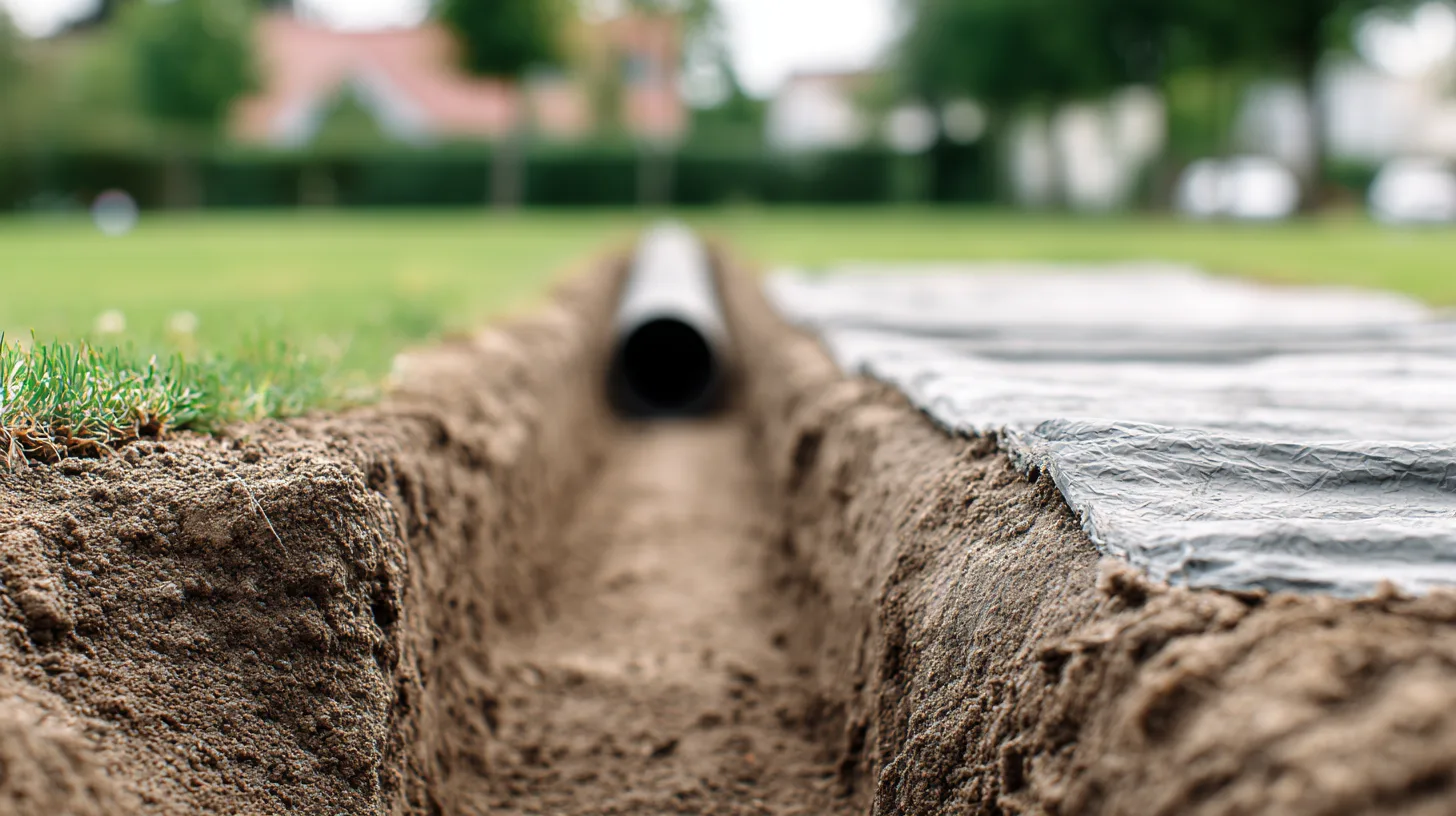
Lining cures a new pipe inside the old one, so the old one has to hold its shape while that happens. A line that is corroded but continuous is a good candidate. A collapsed section is not, because there is nothing to line against.
Severe offsets at joints, a line that has lost grade so waste no longer runs downhill, and belly sections where water stands are the other common disqualifiers. None of those are fixed by a new internal surface — the geometry is the fault.
This is the reason a camera inspection is not optional before a repair decision. The choice between a three-day job and a six-week one is made on what the camera shows, and a quote issued without one is a quote issued without the deciding fact.
Why Collier County has so much of this work
The housing stock is the right age for it.
Collier County has a very large proportion of homes built before 1972 with cast iron drain lines underground (Revolution Florida, 2026). Cast iron corrodes from the inside, so the pipe wall thins and roughens while the line still passes water — the failure is well advanced before anything surfaces as a symptom.
Local ground conditions accelerate it. A high water table keeps the exterior of buried pipe permanently wet, and soil movement after heavy rain shifts and stresses joints (First Choice Plumbing Solutions, 2026).
Stressed joints are also where roots enter, which is why root intrusion and structural failure so often turn up on the same camera inspection in this market. They are two symptoms of the same underlying age.
How much does sewer line repair cost in Naples?
A spot repair and a full replacement are different orders of magnitude. Which one you need is decided by the camera, not by the quote.
The spread is wide because the jobs are not the same job. A spot repair on a 5 to 10 foot section typically runs $1,500 to $4,000, while a full replacement by traditional excavation runs $5,000 to $15,000 or more (Four Seasons, 2026). Overall, sewer line replacement sits between $3,000 and $15,000 in 2026 depending on length, depth, method and what is sitting on top of the line (Four Seasons, 2026).
By the foot, traditional excavation runs roughly $50 to $250 per linear foot and trenchless methods $60 to $300 (Four Seasons, 2026). CIPP lining is the most predictable of the group, quoted in a comparatively narrow band of $70 to $150 per linear foot (Charles & Hudson, 2026).
Permits are separate and easy to forget. Expect roughly $250 to $600 for residential work, and $500 to $1,500 where the job enters the public right of way (Charles & Hudson, 2026).
The number that actually decides your cost is length, and length is a function of your lot. This is why the same fault costs differently in Naples Park and in Pine Ridge, where lots run one to three acres and the private lateral is correspondingly long.
Is trenchless repair cheaper than digging?
Usually, and the reason is not the pipe work. It is the restoration cost that excavation adds and trenchless avoids.
Trenchless methods such as pipe lining and pipe bursting generally run 30 to 40 percent less than traditional excavation (Charles & Hudson, 2026). But the headline per-foot rates do not show why, because on a per-foot basis trenchless can look more expensive.
The difference is what happens above the pipe. Traditional excavation adds roughly $3,000 to $8,000 in restoration costs beyond the base repair price — the driveway, the landscaping, the irrigation, whatever was over the trench — and trenchless largely eliminates them (Charles & Hudson, 2026). That is the money most quotes discuss last and most homeowners discover afterwards.
Which is why the honest comparison is not per foot. It is the total, including restoration, for your specific property. On a compact lot with a short run under grass, digging may genuinely be cheaper. On a mature property with a long lateral under a paver driveway and forty years of planting, it usually is not.
| Method | Typical cost | What it means above ground |
|---|---|---|
| Spot repair, 5–10 ft | $1,500–$4,000 (Four Seasons, 2026) | One small excavation. Suitable when the camera finds a single localised fault. |
| CIPP lining | $70–$150 per ft · $4,000–$10,000 full line (Charles & Hudson, 2026) | Minimal disturbance. The most predictable pricing of the group. |
| Pipe bursting, 30–60 ft | $6,000–$15,000 (Charles & Hudson, 2026) | Access pits only. Replaces rather than lines the pipe. |
| Traditional excavation | $5,000–$15,000+ (Four Seasons, 2026) | Open trench, plus $3,000–$8,000 restoration not in the base price. |
| Permits | $250–$600 residential · $500–$1,500 right of way (Charles & Hudson, 2026) | Separate from the repair on every method. |
How do I know whether I need a repair at all?
A camera answers it and nothing else does. Recurring blockages, multiple fixtures at once and sewage smell are reasons to look, not reasons to dig.
The symptoms that point at the line rather than at a fixture are: several fixtures affected together, particularly the lowest ones; blockages that return at the same point on a shortening interval; and gurgling or smell that arrives with use elsewhere in the house.
None of those tells you what is wrong or where. A camera does both, and on an acreage lot a locator afterwards fixes the point on the surface — which is what keeps the work to a section rather than a run, and keeps the restoration bill in the hundreds rather than the thousands.
It is worth being blunt about the incentive here. A quote for full replacement produced without a camera is a quote written without knowing whether full replacement is needed. Ask to see the footage, and ask what distance along the line the fault sits at. Both are reasonable questions and both are quick to answer.
What does the repair actually involve, start to finish?
Locate, expose, repair, test, restore. The middle step is short and the two on either side are where the time goes.
Locating comes first and is non-negotiable, because everything after it is priced from the position it establishes. A camera identifies the fault and its distance along the run; a locator fixes that point on the surface, usually within a foot or so, and marks it.
Exposing the line is the step that varies most by property. On open ground with a shallow lateral it is straightforward. Under a driveway, a pool deck or mature planting it is the largest single component of the job, and it is the reason trenchless methods exist at all.
The repair itself is often the quickest part. Replacing a failed section of a few feet, or lining a run, is measured in hours once access exists. This surprises people who have priced the job and reasonably assumed the cost tracked the difficulty of the plumbing.
Testing before backfill is the step worth insisting on. The line should be run and observed, ideally with the camera again, before anything is covered. A repair that is buried and then found to be incomplete costs the excavation twice, and the second excavation is not cheaper than the first.
Restoration closes it out and belongs in the original quote. Backfill and compaction matter more than they sound: poorly compacted fill settles, and settlement over a repaired line is how a new belly forms in the same place a few years later. Surface reinstatement — turf, pavers, concrete, planting — is the visible part and the part most likely to have been priced optimistically.
Where the work enters the public right of way, permitting and inspection add both time and a fee, typically $500 to $1,500 at that level (Charles & Hudson, 2026). That is worth knowing at quote stage rather than discovering when the schedule moves.
Who is responsible for the pipe between the house and the main?
You are, on almost every property. The utility owns the main and generally nothing on your side of it.
The private lateral runs from the building to the connection at the public main, and on the great majority of properties every foot of it is the owner's responsibility to maintain, repair and replace. This surprises people who reasonably assume that anything buried in the street-facing part of the lot belongs to somebody official.
The practical consequence scales with lot size. On a compact lot the lateral is short and the exposure is limited. On acreage the same responsibility covers a much longer run, more joints and more opportunity for roots and settlement, which is why identical faults produce very different bills across the same city.
Where the line crosses into the public right of way the picture changes and permitting enters, typically $500 to $1,500 at that level (Charles & Hudson, 2026). Work in the right of way is generally still the owner's cost, but it is not the owner's to schedule unilaterally.
There is one case worth checking before assuming: a backup whose cause is a blockage or surcharge in the main itself is the utility's problem, not yours. If several neighbouring properties are affected at once, or the backup coincides with heavy rain across the area, that is worth reporting before paying anyone to clear a lateral that may not be blocked.
Questions about this work
Direct answers, no sales pitch.
 JAMIE KLONCZ · GREAT HERON PLUMBING ONLINE
 Pick a question on the left, or search above. You will get the direct answer, the way an answer engine would give it.
What does a repipe actually involve in a home like yours?
Three questions about the house. You get the scope and how long the water is off — the two things that actually decide what a repipe means for you. No price is shown here, because pricing depends on a walkthrough of the real house.
Indicative scope only, not a quote and not an inspection. Actual scope is set by a walkthrough of the real house.
Sources
- Fla. Stat. 489.119(5)(b) — Business organizations; qualifying agents (Online Sunshine)
- Licensing Portal — License Search, Florida Department of Business and Professional Regulation
- Naples Trenchless Sewer Pipe Lining
- Cast Iron Pipe Replacement Cost in Older Florida Homes (2026) — Revolution Florida
- What Causes Slab Leaks In Florida: A 2026 Homeowner’s Guide — First Choice Plumbing Solutions
- Sewer Line Repair Cost 2026 Guide — Four Seasons
- Sewer Line Repair Cost Guide for 2026 — Charles & Hudson
Where we work
Contact
Tell us what is happening
The more you can say about the property — the neighbourhood, roughly when it was built, and what it is connected to — the more useful the first answer will be.
Call (239) 404-8590