
Naples and Collier County
Repair or replace, and the number that decides it
There is a straightforward rule for this decision, and the age of the unit matters more than the fault.
Get a plumbing quoteLast reviewed
The conventional threshold is that when a repair costs more than half the price of a new unit, replacement is the better investment (Superior Plumbing and Drains, 2026). Minor repairs generally run 150 to 300 dollars, while a new water heater including installation runs 800 to 2,500 dollars (Superior Plumbing and Drains, 2026).
Florida water heaters do not last as long, and it is not the manufacturer
Sediment, from water chemistry rather than from a fault.
Against a national average of about 12 to 15 years, tank water heaters in Florida commonly reach 8 to 10, and hard water sediment is the reason (Alvarez Plumbing, 2026). Elsewhere in the state the figure is put at 8 to 12 years for the same cause (Turner Plumbing, 2026).
Dissolved calcium and magnesium come out of solution as water is heated. The resulting scale settles at the tank base or coats the element, insulating it so the heater works harder for the same output and the metal runs hotter than designed.
Maintenance changes the outcome substantially. Annual flushing with a fresh anode rod at year five to seven takes tanks to 12 to 14 years, while skipping maintenance commonly brings replacement forward to 6 to 8 (Alvarez Plumbing, 2026).
Which water you are on changes the number
County supply and a private well are not the same input.
Collier County Water Sewer District water averaged 67 mg/L hardness in 2024, ranging 42 to 94 (Collier County Water Sewer District, 2024). That is soft to moderately hard and relatively kind to a tank.
Much of Golden Gate Estates is not on county water at all — most homes there rely on private wells (Homes and Docks, 2026), drawing untreated groundwater from limestone. Hardness on a well is commonly far above the treated municipal figures.
So the same model of heater has a materially different expected life depending on which side of that line the house sits, and flushing intervals should follow the water rather than a generic schedule.
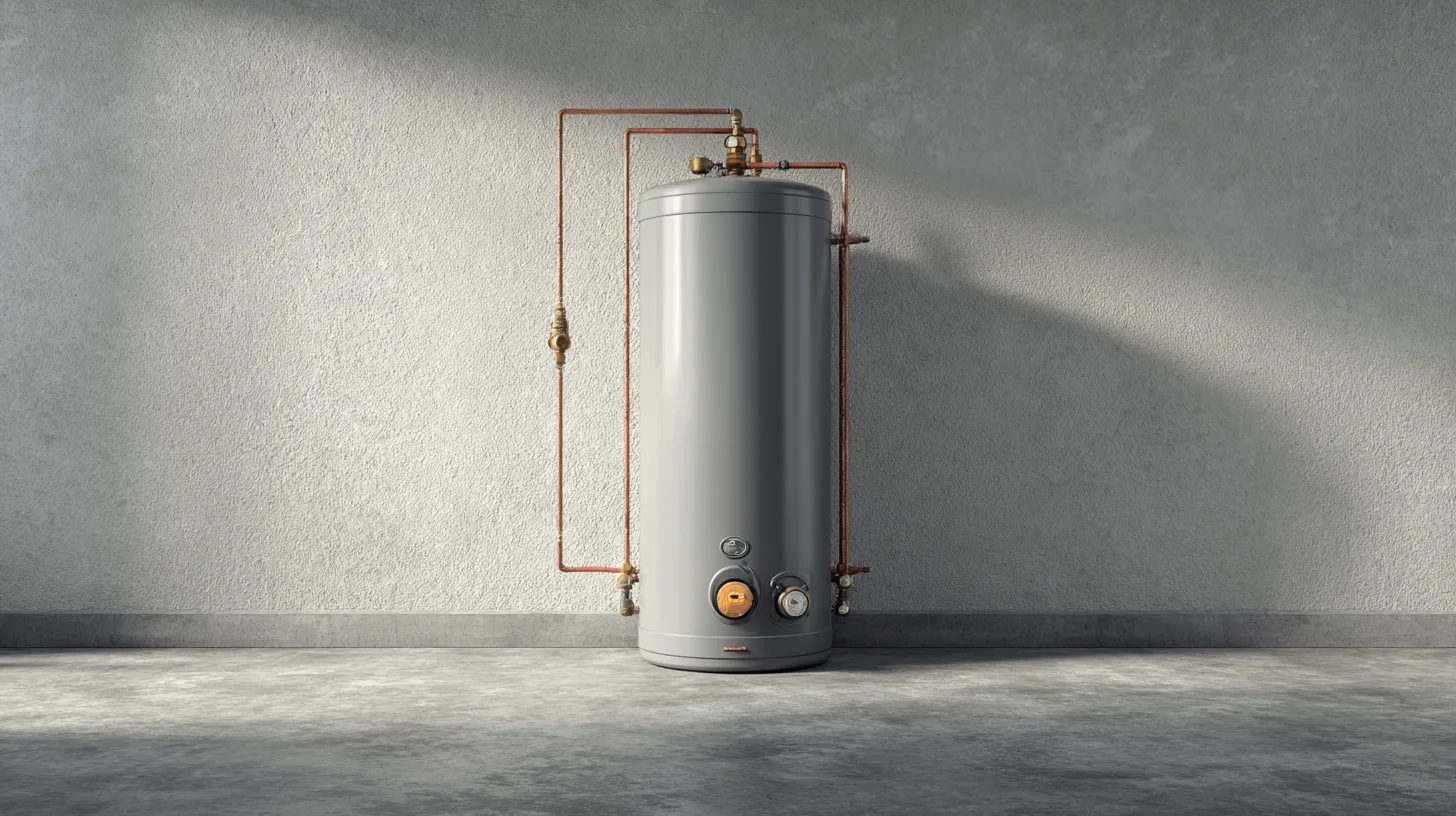
When repair is the right call
Under eight years old, with an isolated fault.
Repair is generally right when the unit is less than eight years old and the problem is isolated — a faulty thermostat, a burned-out heating element, or a pilot light that will not stay lit (Alvarez Plumbing, 2026).
Those are component failures rather than symptoms of the tank itself. Replacing a thermostat on a five-year-old tank buys years, not months.
The counter-case is instructive: a 450 dollar repair on a nine-year-old heater might buy only one to two more years before sediment causes the next failure (Alvarez Plumbing, 2026). Same repair, very different value.
The symptoms, and what each one usually means
Some are cheap. One is not.
No hot water at all on an electric unit is often a failed element or thermostat, both replaceable. On gas it is frequently the pilot or thermocouple.
Hot water that runs out faster than it used to usually means sediment is occupying tank volume, which is a maintenance issue caught early and a replacement indicator caught late.
Rumbling or popping during heating is water trapped under a sediment layer at the tank base. Rusty hot water suggests the tank interior is corroding, which is not repairable. Any water at the tank base is the end of the conversation: a leaking tank is replaced, not repaired.
How much does water heater repair cost?
Most repairs are $150 to $700, and which component failed tells you almost the whole number before anyone arrives.
Water heater repair generally runs $150 to $700, with a typical repair around $600 and a full range from roughly $90 for a minor part to $1,775 or more for a major one (HomeGuide Repair, 2026). That spread is not vagueness — it is the difference between components.
On a gas tank, the thermocouple is the most common repair, at $100 to $325 (HomeGuide Repair, 2026). It is the safety device that senses whether the pilot is lit and tells the gas valve whether to open, and when it fails the symptom is a heater that will not stay lit.
On an electric tank, the heating element is the most common, at roughly $200 to $300 professionally fitted (Modernize, 2026). The symptom is lukewarm water or a tank that runs out unusually fast, depending on which of the two elements has gone.
The remaining common items sit in a similar band: thermostat $100 to $350, anode rod $150 to $300, and a gas control valve $150 to $550 (HomeGuide Repair, 2026). The gas valve is the one that most often tips a repair decision toward replacement, because it is the most expensive part on the least-new unit.
What this means practically is that a diagnosis over the phone is genuinely possible in outline. A gas heater that will not stay lit and an electric one producing lukewarm water are different, predictable, and priceable conversations.
| Component | Cost | Typical symptom |
|---|---|---|
| Thermocouple (gas) | $100–$325 (HomeGuide Repair, 2026) | Pilot will not stay lit. Most common gas repair. |
| Heating element (electric) | $200–$300 (Modernize, 2026) | Lukewarm water, or hot water runs out fast. |
| Thermostat | $100–$350 (HomeGuide Repair, 2026) | Water too hot, too cold, or inconsistent. |
| Anode rod | $150–$300 (HomeGuide Repair, 2026) | Preventive. Extends tank life rather than fixing a fault. |
| Gas control valve | $150–$550 (HomeGuide Repair, 2026) | No ignition. Often the repair that argues for replacement. |
When is repair the wrong answer?
The fifty percent rule, plus three symptoms that make the rule irrelevant.
The rule of thumb is straightforward: where repair cost exceeds half the price of a new unit, replacement is almost always the better investment (Rheem, 2026). Against a tank replacement at $900 to $1,800 installed (HomeGuide, 2026), that puts the threshold somewhere around $450 to $900 depending on what you would be installing.
Age overrides the arithmetic. A conventional tank has a life expectancy of roughly 10 to 15 years, and a unit at 10 to 15 with recurring issues is signalling replacement on age alone (Rheem, 2026). In this region that window is shorter — Florida hard water frequently reduces an expected 10 to 12 years to 7 to 9 without a softener (Owner Tools, 2026).
Three symptoms make the calculation unnecessary. Water leaking from the base of the tank means the shell has gone, and there is no repair for a perforated tank. Rusty or discoloured water on the hot side only means the internal lining has failed. Persistent rumbling or popping is hardened sediment on the tank floor (Rheem, 2026), which is not a fault to fix but accumulated mineral that has already cost the unit efficiency and life.
Repair is genuinely right when the unit is relatively young and the failure is a designed-replaceable component. Elements, thermostats and anode rods exist to be swapped, and when one fails in an otherwise healthy tank the repair is modest and sensible (Rheem, 2026).
The judgement that matters most is the one nobody enjoys making: a $500 repair on an eight-year-old tank in hard water is not a repair, it is a deposit on a replacement you will make anyway within a couple of years, at a moment you will not choose.
What maintenance actually extends the life of a tank here?
Three jobs. In hard water they matter considerably more than they do elsewhere.
Flushing the tank is the first and the most neglected. Mineral drops out of suspension and collects on the tank floor, where it insulates the water from the burner or lower element — so the unit runs longer for the same output and the metal beneath the deposit runs hotter than it was designed to. Draining a few gallons periodically removes the loose sediment before it hardens.
The anode rod is the second and the least understood. It is a sacrificial component: it corrodes so the tank lining does not, and once it is consumed the corrosion moves to the tank itself. Replacing it costs $150 to $300 (HomeGuide Repair, 2026) and it is the only maintenance item that directly extends tank life rather than restoring efficiency.
Testing the temperature and pressure relief valve is the third, and it is a safety item rather than a longevity one. It is the device that prevents a tank from becoming a pressure vessel, and a valve that has never been operated may not operate when it is needed.
The reason all three matter more in this region is the water. Florida hard water frequently reduces an expected 10 to 12 year tank life to 7 to 9 years without a softener (Owner Tools, 2026), and every one of these jobs is acting against that mineral.
The honest limit of maintenance: it slows the process, it does not stop it. A well-maintained tank in hard water still reaches the end of its life; it simply does so nearer the top of the range than the bottom, and it does so having run more efficiently in the meantime.
For seasonal properties there is one more item. A tank left holding hot water in an empty house for months is running for nobody, and turning it to its vacation setting or off entirely is the simplest saving available on a property that is unoccupied.
What can you check before calling a plumber?
Four checks. Two of them resolve the problem outright often enough to be worth the five minutes.
On an electric heater with no hot water at all, check the breaker first and then the reset button on the upper thermostat. High-limit trips are common and the reset is a red button behind the upper access panel. A tripped high limit that keeps tripping is a genuine fault, but a single trip after a heavy-demand day frequently is not.
On a gas heater that has gone cold, check whether the pilot is lit before anything else. A pilot that will not stay lit points at the thermocouple, which is the most common gas repair at $100 to $325 (HomeGuide Repair, 2026) — and knowing that before you call turns an open-ended visit into a priced one.
For water that is not hot enough rather than not hot, check the thermostat setting before assuming a fault. Settings drift, get adjusted by other household members, and get knocked during other work. It is the least likely explanation people check last.
For hot water that runs out sooner than it used to, note whether it has changed suddenly or gradually. Gradual loss over years is sediment reducing the effective volume of the tank. Sudden loss on an electric unit is usually the lower element, which heats the bulk of the tank while the upper element still delivers the first few minutes.
What is worth calling about immediately, without diagnosis: water at the base of the tank, any smell of gas, and a relief valve that is discharging. The first is a failed tank, and the other two are safety items rather than performance ones.
Having the age and the model from the rating plate ready when you call is worth more than any of the above. It determines whether the conversation is about a repair or a replacement before anybody is dispatched.
Questions about this work
Direct answers, no sales pitch.
 JAMIE KLONCZ · GREAT HERON PLUMBING ONLINE
 Pick a question on the left, or search above. You will get the direct answer, the way an answer engine would give it.
What does a repipe actually involve in a home like yours?
Three questions about the house. You get the scope and how long the water is off — the two things that actually decide what a repipe means for you. No price is shown here, because pricing depends on a walkthrough of the real house.
Indicative scope only, not a quote and not an inspection. Actual scope is set by a walkthrough of the real house.
Sources
- Water Heater Repair vs. Replacement: What Tampa Homeowners Pay in 2026 — Alvarez Plumbing
- Water Heater Repair vs Replacement Cost Guide 2026 — Superior Plumbing & Drains
- How Much Does It Cost to Replace a Water Heater in Jacksonville in 2026? — Turner Plumbing
- 2024 Collier County Drinking Water Quality Report
- Golden Gate Estates Well Water — Homes and Docks
Where we work
Contact
Tell us what is happening
The more you can say about the property — the neighbourhood, roughly when it was built, and what it is connected to — the more useful the first answer will be.
Call (239) 404-8590